Powertrain Economics
Choosing between a diesel and a gasoline engine is no longer a simple matter of calculating miles per gallon. Modern emissions standards have fundamentally changed the cost architecture of heavy-duty trucks. A diesel engine today is a sophisticated chemical plant on wheels, utilizing Selective Catalytic Reduction (SCR) and Diesel Particulate Filters (DPF) to meet stringent EPA requirements.
In my experience consulting for regional construction fleets, I’ve seen buyers get seduced by the 1,000+ lb-ft of torque offered by a modern Cummins or Power Stroke without accounting for the $9,000 to $12,000 MSRP premium. Gasoline engines, like the Ford 7.3L Godzilla or the Ram 6.4L HEMI, have closed the capability gap for many users, offering simpler maintenance at the expense of lower fuel efficiency and shorter engine longevity.
Statistically, the average diesel truck owner will spend approximately $1,500 to $2,500 more per year on routine maintenance and DEF (Diesel Exhaust Fluid) compared to a gasoline counterpart. However, the diesel variant often retains 60-70% of its value after five years, whereas gasoline heavy-duty trucks typically hover around 45-50% in the same timeframe.
Why Buyers Miscalculate
The most common mistake is the "Idling Trap." Diesel engines are designed to work under load; frequent short trips and excessive idling lead to "clogged" DPF systems. A forced regeneration at a dealership can cost $500, while a full DPF replacement can exceed $4,000. Many owners buy a diesel for a 5-mile commute and occasional weekend towing, which is the fastest way to erode any potential ROI.
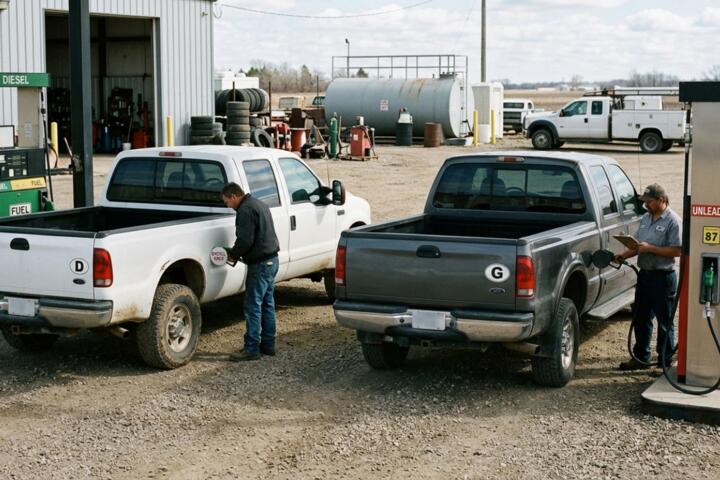
Another pain point is the complexity of the fuel system. A single tank of contaminated diesel can destroy high-pressure fuel pumps and injectors. In a Bosch CP4 pump failure scenario, the repair bill often hits $10,000 because the entire fuel system must be flushed of metal debris. Gasoline systems operate at much lower pressures and are significantly more resilient to minor fuel quality variances.
Ignoring the "Opportunity Cost" of the initial investment is a critical error. If you spend $10,000 extra on a diesel engine, that is capital not being invested elsewhere. Over a five-year ownership period, that $10,000 could have earned 7-10% annually in a diversified index fund. To justify the diesel, the fuel savings and resale value must not only cover the $10,000 but also the lost interest on that capital.
Truck Investment Tips
The 20,000-Mile Annual Threshold
For most commercial and private users, the "break-even" point for diesel typically occurs around 20,000 to 25,000 miles per year. If your annual mileage is lower, the fuel savings rarely offset the higher insurance, registration, and oil change costs. Analyze your past three years of logs via services like Fleetio or Motive to see where your actual mileage sits before committing to a powertrain.
Advanced Filtration as an Insurance Policy
If you choose diesel, install a secondary fuel filtration and water separator system from brands like FASS or AirDog. These systems remove air and water more efficiently than factory filters, protecting $3,000 injector sets. This $700 investment can prevent a $10,000 catastrophic failure, effectively lowering your "risk-adjusted" cost of ownership over 200,000 miles.
Optimizing for Low-End Torque Requirements
Evaluate your "Duty Cycle." If you are towing over 15,000 pounds more than 40% of the time, the diesel's exhaust brake and low-end torque are safety necessities, not just luxuries. The reduction in brake wear alone on long descents can save $800 in rotor and pad replacements over the life of the vehicle compared to a gasoline truck struggling to maintain engine braking.
Fluid Analysis and Predictive Maintenance
Don't follow the "Oil Life Monitor" blindly. Use a service like Blackstone Laboratories to perform oil analysis every 7,500 miles. For $35, you get a report on wear metals and fuel dilution. This is especially critical for diesel engines with complex EGR systems. Catching a coolant leak or excessive soot early can save an entire engine block, which costs upwards of $20,000 to replace.
Resale Timing and Market Liquidity
The sweet spot for selling a diesel truck to maximize ROI is usually right before the 100,000-mile powertrain warranty expires. Buyers on platforms like Bring a Trailer or Autotrader pay a significant premium for trucks that still have "factory protection." Conversely, gasoline trucks should be held longer or sold much earlier, as their value drops more linearly with mileage.
Factor in the DEF and Fuel Price Delta
Always calculate the "Spread." Diesel fuel is often $0.50 to $1.00 more expensive per gallon than 87-octane gasoline. Combined with the 2-3% of fuel volume consumed as DEF, the "per mile" fuel cost of diesel is often closer to gasoline than the MPG figures suggest. Use specialized apps like GasBuddy or TSD Logistics (for fleet discounts) to narrow this gap.
Powertrain Case Studies
Case Study 1: Alpine Landscaping & Excavation
This company operated a fleet of five 3/4-ton trucks. They initially used all diesel models for local deliveries. After three years, they realized that three of the trucks averaged only 12,000 miles annually with high idle times. These three trucks suffered from constant EGR valve soot buildup, costing $4,500 in non-warranty repairs. They traded them for 6.6L Gas models. Result: Annual maintenance costs dropped by 38%, and the reduced insurance premiums saved an additional $1,200 per year.
Case Study 2: Long-Haul Equestrian Transport
A private hauler moved horses across state lines, averaging 45,000 miles per year. They switched from a big-block gasoline engine to a High-Output diesel. Despite the $12,000 up-front cost, the diesel's 11 MPG (towing) versus the gas truck's 6 MPG saved them over $9,500 in fuel costs in the first year alone. After four years, the truck was sold for $15,000 more than a comparable gas model would have fetched, resulting in a total net gain of $43,000.
5-Year Ownership Matrix
| Cost Category | Heavy-Duty Gasoline (V8) | Heavy-Duty Diesel (Turbo) |
|---|---|---|
| Initial Option Cost | $0 (Base) | $9,500 – $12,500 |
| Average Maintenance (Annual) | $400 – $600 | $1,200 – $1,800 |
| Fuel Efficiency (Unloaded) | 12 – 15 MPG | 17 – 21 MPG |
| Fuel Efficiency (Towing 12k lbs) | 6 – 8 MPG | 11 – 13 MPG |
| DEF Consumption | $0 | $200 – $400 per year |
| 5-Year Resale Value | 45% – 52% | 65% – 75% |
Used Market Pitfalls
When buying used, "The Delete" is a major red flag. Many owners remove emissions equipment (DPF/EGR) to improve reliability. While this may help the engine breathe, it makes the truck illegal to sell in many states and voids any remaining warranty. From a resale perspective, a "deleted" truck has a smaller pool of buyers and can be a liability during inspections.
Check the "Idle Hours" vs. "Drive Hours" in the dashboard menu. A truck with low mileage but high idle hours (common in oil field or construction trucks) has significantly more wear than a high-mileage highway truck. For a diesel, every idle hour is roughly equivalent to 25-30 miles of engine wear and contributes heavily to DPF clogging.
FAQ
Is diesel still worth it if I only tow once a month?
Generally, no. The higher maintenance costs and the potential for emissions system issues caused by infrequent use usually outweigh the towing benefits. A modern "Big Gas" engine is more than capable for monthly recreational towing.
How much does a diesel oil change actually cost?
Expect to pay between $180 and $300. A diesel engine like the 6.7L Power Stroke holds 13-15 quarts of oil, and the filters are significantly more expensive than those for gasoline engines. DIY can save money, but the disposal of 4 gallons of oil is a logistical factor.
Which engine lasts longer?
While the diesel block itself is often rated for 350,000+ miles (B10 life), the components surrounding it (turbos, injectors, sensors) often require expensive service at 150,000 miles. A gasoline engine may only last 200,000 miles, but those miles are often cheaper to achieve.
Does diesel fuel go bad faster than gas?
Diesel is more susceptible to microbial growth (algae) and "waxing" in cold weather. If a diesel truck sits for months, you must use a stabilizer like Stanadyne or Howe’s. Gasoline degrades too, but it doesn't support biological growth like diesel can.
What is the "Diesel Tax"?
This refers to the combination of the higher purchase price, higher fuel price, and more expensive parts. In states like California or New York, registration fees for diesel trucks are also frequently higher based on weight and emissions classes.
Author’s Insight
I’ve spent two decades analyzing truck telemetry for construction firms, and my personal philosophy is simple: buy the tool that fits the 90% use case, not the 10% "what if" scenario. I often see people buy a heavy-duty diesel because they plan to buy a large 5th-wheel trailer "someday." If that "someday" is three years away, you are burning thousands of dollars in maintenance and depreciation in the meantime. My best advice? If you aren't pulling at least 10,000 pounds weekly, stick with the modern high-displacement gasoline engines. Your bank account will thank you.
Summary
The choice between diesel and gasoline boils down to your specific annual mileage and towing frequency. Diesel offers unmatched resale value and towing efficiency but requires a disciplined maintenance schedule and high utilization to break even. Gasoline engines provide lower entry costs and simplified repairs, making them the superior choice for light-duty cycles and lower annual mileage. Calculate your projected three-year fuel spend, add the MSRP premium, and compare it against the estimated residual value before signing the papers.